
Reality check: How billionaires broke democracy to get richer—and what we can still do about it
You've felt it.
Your grocery bills keep rising. Your blood pressure too. You open Facebook and within minutes you're furious at your neighbor's political post. You scroll Twitter and your heart races. You watch YouTube and the recommendations get more extreme. You argue with strangers online about things that didn't matter yesterday.
And you can't stop.
You know it's bad for you. You know it's making you angrier, more anxious, more divided from people you used to get along with.
While you were feeling this way, something historic happened: In 2025, billionaire wealth hit a record $18.3 trillion—growing three times faster than the previous five years. The top 10 alone gained $579 billion. In one year.
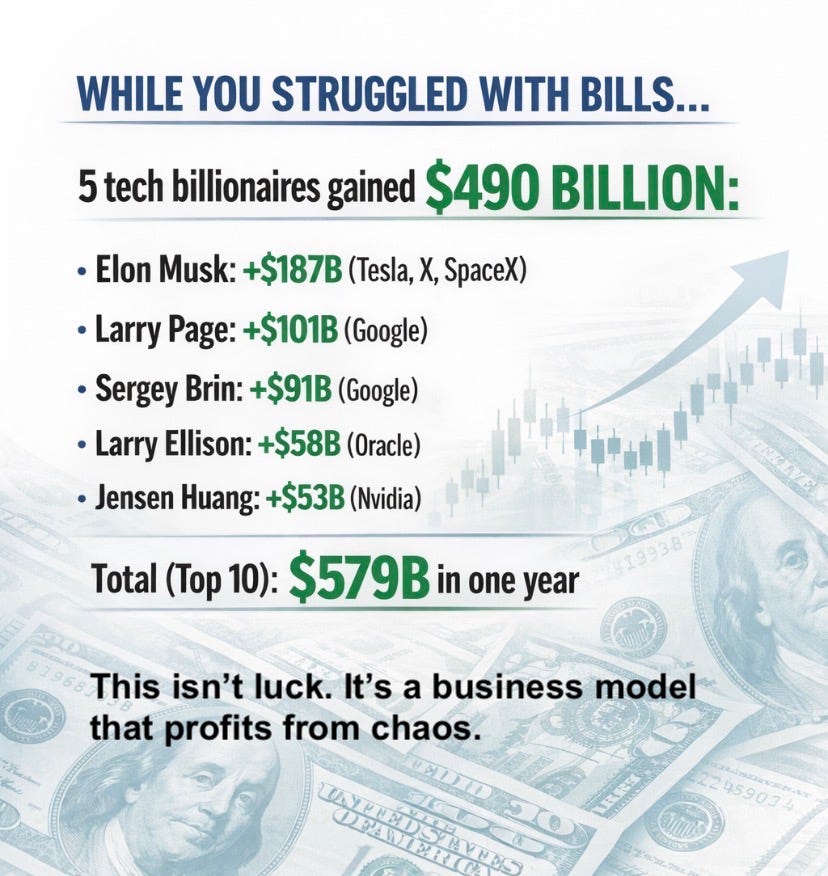
And the chaos that made them rich is the same chaos fracturing democracy.
Let me show you how the pieces fit together—and why understanding this changes everything.
What You're Living Through
You feel more divided from family, neighbors, coworkers—people you used to get along with just fine.
Politics feels more insane than ever. More extreme. More urgent. More constant.
The news is overwhelming. Everything is breaking news. You can't keep up and you can't look away.
You're angrier more often. About more things. At more people.
Social media feels toxic but you can't leave. You've tried. You always come back.
Nothing you learned in civics class seems to work anymore. Congress is incapacitated. Institutions are collapsing. Both parties seem corrupt. Voting feels pointless.
You're not imagining it. And you're not crazy.
Something fundamental broke. And it broke on purpose.
The Simple Truth: Your Anger = Their Money
Here's what's actually happening behind what you're experiencing:
Social media companies make more money when you're angry than when you're happy.

That's it. That's the core business model.
Angry people click more. Share more. Comment more. Stay online longer. Come back more often.
More time online = more ads shown = more money made.
They literally profit from your outrage.
This isn't speculation. Internal documents—leaked by whistleblower Frances Haugen—proved Facebook knew this. One presentation stated: "Our algorithms exploit the human brain's attraction to divisiveness."
They knew feeding you divisive content would keep you scrolling. They knew it was harmful. They did it anyway because it was profitable.
Research confirmed it: Posts containing moral outrage get 20% more engagement. False news spreads faster and farther than truth. The algorithm doesn't optimize for what's true or healthy—it optimizes for what keeps you scrolling.
And what keeps you scrolling is rage.
Facebook and Google made over $300 billion in one year from ads. Those ads work because you're angry and can't stop scrolling.
The Formula That Fractured Democracy
Behind the chaos you're experiencing is a simple formula:
Step 1: Flood Your Brain Until You Can't Think Straight
Ever feel like you can't keep up with information anymore? Like everything is breaking news and you're always behind?
That's intentional. Steve Bannon—Trump's former chief strategist—said it explicitly: "The way to deal with the media is to flood the zone with shit."
When everything is urgent, nothing is. When every claim demands immediate attention, you stop being able to think critically. You just react.
Elon Musk posts dozens of times daily—mixing memes, policy positions, half-truths, conspiracies. The goal isn't to inform. It's to overwhelm you into a permanent state of crisis that keeps you refreshing, scrolling, reacting.
Overwhelmed people don't organize. They don't think strategically. They just keep scrolling.
Step 2: The Algorithm Learns What Makes You Angriest
The more you engage with content that enrages you, the more the algorithm shows you content designed to enrage you.
Not because it wants to radicalize you. Because angry people are profitable people.
YouTube's algorithm consistently recommends increasingly extreme content to maximize watch time. A former YouTube engineer confirmed: "YouTube's AI doesn't optimize for what is true or balanced—it optimizes for watch time."
Facebook's own research found that 64% of people who joined extremist groups got there because Facebook's algorithm recommended them.
They knew. They amplified it anyway. Because engagement equals money.
Step 3: Chaos Keeps You Scrolling
Political chaos means you're constantly checking for updates. Manufactured outrage means you can't look away.
The more destabilized you feel, the more you scroll.
The more you scroll, the richer they get.
Every minute of your anxiety generates money for them.
Step 4: Division Protects Their Profits
Here's the part most people miss:
While you're fighting with your neighbor about politics, you're not organizing against the companies making billions from the fight.
While Congress is paralyzed by partisan warfare, they're not regulating the platforms creating the warfare.
The destabilization and division distraction and protection.
When you're too busy being angry at the "other side," you're distracted from questioning the motivations of the oligarchs profiting from keeping you divided.
Division is the product they're selling.
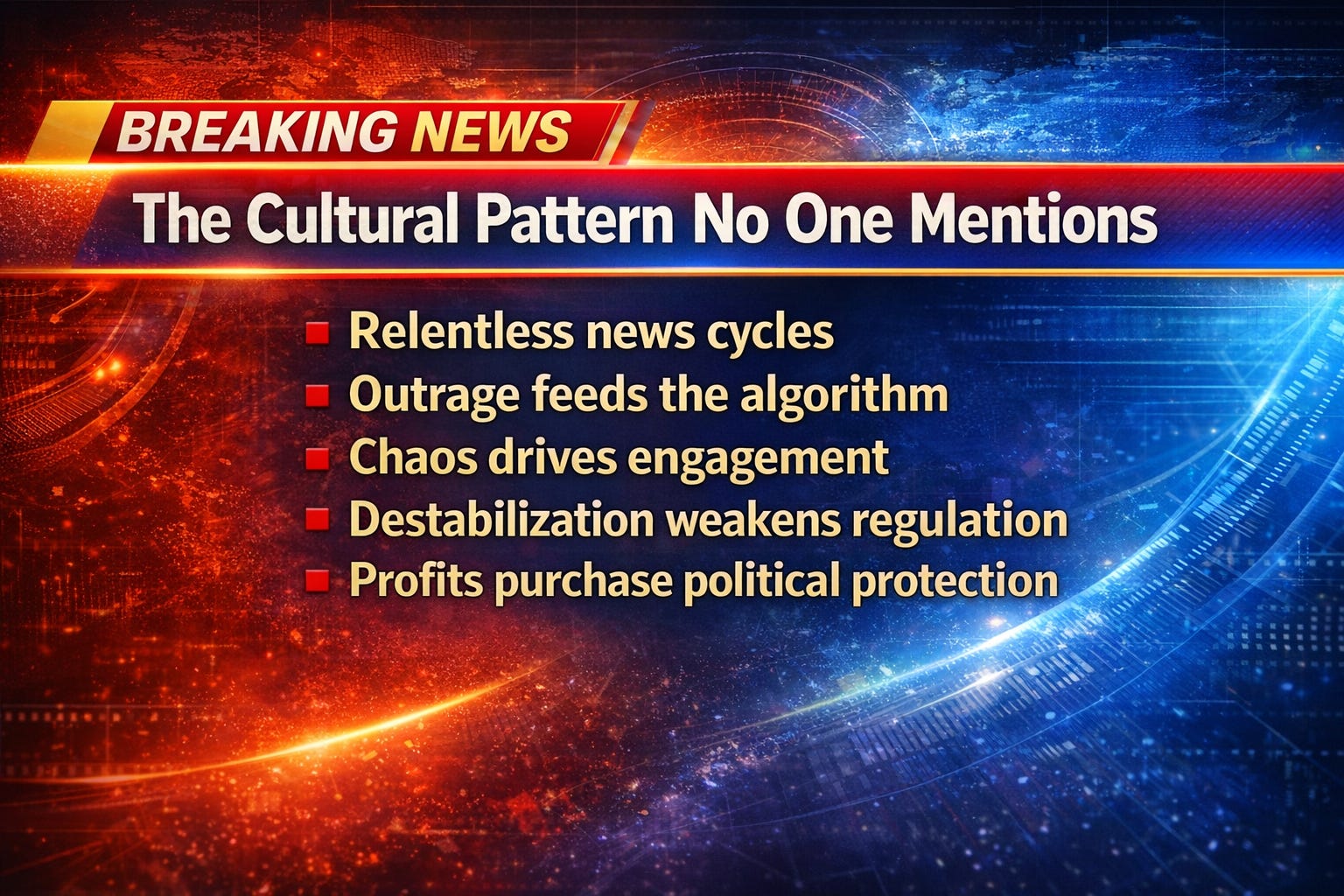
Step 5: Profits Buy Political Protection
Those billions in profits? They spent them on politicians. From BOTH parties.
One billionaire—Elon Musk—spent $288 million electing politicians in 2024. The largest political donation in U.S. history.
Tech companies spent $482 million on lobbying Congress over ten years.
They donated millions to Democrats AND Republicans.
Result: Both parties now depend on tech money. Neither will regulate the platforms.
The 2025 Wealth Explosion
Let me put this in numbers you can understand:
Billionaire wealth hit a record $18.3 trillion in 2025—the highest in history. Over 3,000 billionaires now exist—the first time that threshold was crossed.
Their combined wealth increased by $2.5 trillion in 2025. That's almost equivalent to the total wealth held by the bottom half of humanity—4.1 billion people.
The top 10 richest gained $579 billion:
Elon Musk: +$187B (now worth $619B—first person to surpass $600B)
Larry Page (Google): +$101B
Sergey Brin (Google): +$91B
Larry Ellison (Oracle): +$58B
Jensen Huang (Nvidia): +$53B
The pattern: Every major gain traces back to algorithmic engagement systems or cloud computing for AI.
The companies that perfected engagement-based chaos were perfectly positioned to profit from the AI boom. AI companies needed their infrastructure, their data, their distribution—all built on keeping you scrolling.
Meanwhile, what happened to everyone else?
Teen depression doubled since 2010
Rates of self-harm among teenage girls doubled
Political polarization at record highs
Trust in institutions collapsed
Communities fractured
This isn't coincidence. The chaos making them rich is the same chaos tearing society apart.
The Closed Loop: How Democracy Became Too Weak to Fight Back
The money they made from destabilizing democracy was used to purchase the democratic systems that might have stopped them.
The loop:
Platforms destabilize (algorithms amplify outrage, maximize engagement)
Profit massively ($2.5 trillion added to billionaire wealth in 2025)
Buy politicians from both parties ($288M from Musk, $482M in lobbying)
Politicians can't/won't regulate (they depend on the money)
Democracy too fragmented to constrain them (we're here)
Platforms keep destabilizing (cycle accelerates)
This is why nothing changes no matter who you vote for.
Not because votes don't count—they do. But because both parties are financially dependent on the same tech companies profiting from chaos.
When Senator Warren proposed breaking up big tech, the industry spent $100 million in a single quarter lobbying against it. The proposal died.
When California passed privacy laws, tech companies funded efforts to create weaker federal standards.
Every conventional solution—campaign finance reform, antitrust enforcement, algorithmic accountability—requires democratic institutions that still function.
We no longer have that.
They Didn't Just Profit From Destabilization—They Needed It
Democracy constrained their profits. So they systematically weakened it.
Functional democracy would have:
Regulated algorithms that amplify extremism
Broken up monopolies
Protected privacy
Held platforms accountable for harm
Limited political spending
All of that would have reduced profits.
So they built a business model that profits from the chaos that makes regulation impossible.
The destabilization isn't a side effect. It's the product.
But Here's What They Don't Want You to Know
You have more power than you think. You just need to use it differently.
Coordinated Consumer action
In September 2025, Disney lost $5 Billion in one week when they suspended Jimmy Kimmel Live! to appease political pressure. Consumer backlash was immediate:
#BoycottDisney trended
7 million people canceled subscriptions in one month
Disney's market value dropped $5 billion
Disney brought Kimmel back in 6 days
They're vulnerable to coordinated consumer action. Their business model requires YOUR participation. When you refuse—when you organize with others to refuse—they lose money fast.
Localized Community Action
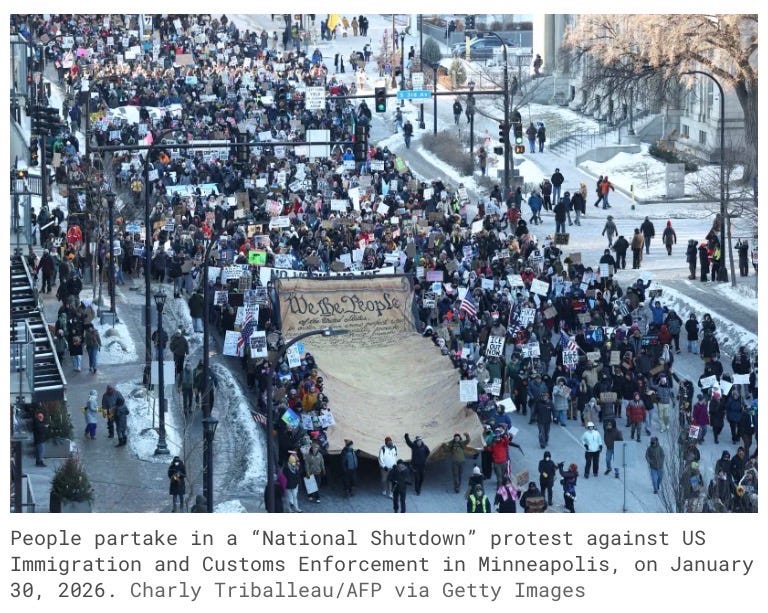
Just last month, Minnesota communities united in action when ICE and CBP agents invaded the state in a show of force, killing two observers.
Federal authorities disrupted daily life and endangered residents as Minneapolis communities organized in localized networks. Neighbors who disagreed about politics agreed about morality and authoritarianism. They showed up in massive numbers.
The pattern: Division = they win. Unity = they're vulnerable.
Face Reality: Democracy Is Lost, But You're Not Powerless
Let me be honest about where we are:
The reality:
Democracy has been severely damaged
Both parties are financially corrupt
Conventional solutions require a functional democracy that’s currently not operational
The window for preventing this has closed
We're not in the warning phase. We're in the aftermath.
But here's the hope:
You're not powerless. You're just using the wrong tools.
Voting still matters—but it's not enough when both parties are purchased.
Awareness still matters—but knowing the system is rigged doesn't unrig it.
Consumer action still matters—but knowing division is an obstacle doesn’t resolve it.
What matters most now:
Stop fighting the people the algorithm told you are enemies. Start organizing with them against the system profiting from the fight.
That person you're arguing with online? They're also getting screwed. They're also angry about corruption. The algorithm showed you their worst posts to keep you divided.
What if you both stopped fighting each other and started organizing against the platforms making billions from the fight?
What You Can Do Now
Here's the honest list of tools to consider:
1. Participate in Coordinated Boycotts
The "Resist and Unsubscribe" campaign (launched February 1, 2026) targets subscription revenue at Amazon, Apple, Google, Meta, Netflix, OpenAI, Uber, and X.
Why it works:
Doesn't require Congress (corrupted)
Hits recurring revenue directly
Creates investor panic
You can do it right now
Reality check: Won't break the business model. But can inflict economic pain. The Disney boycott proved it works.
2. Bridging the Divide
The division you feel is the product they're selling.
Find common ground with people you disagree with politically:
You both hate corruption
You both feel powerless
You both want your kids to have a future
You both resent billionaires getting richer while you struggle
Organize locally, across political lines. Minnesota showed how.
3. International Enforcement Sets an Example
February 3, 2026: French authorities raided Musk's X offices, summoned him for questioning over child sexual abuse material, deepfakes, and algorithmic manipulation.
Musk dismissed it as "political theater."
Why it matters: U.S. regulators won't act (corrupted). European regulators still might have autonomy. International pressure is harder to buy off.
4. Build Alternatives
Support platform cooperatives
Use decentralized social media
Invest in local independent journalism
Create mutual aid networks
Build face-to-face community structures
Reality check: Takes years. Network effects make it hard. But necessary for resilience.
5. Stop Participating
Every time you engage with outrage content, you're feeding the machine.
The most radical act: Stop scrolling. Build real community. Organize face-to-face.
The Big Picture
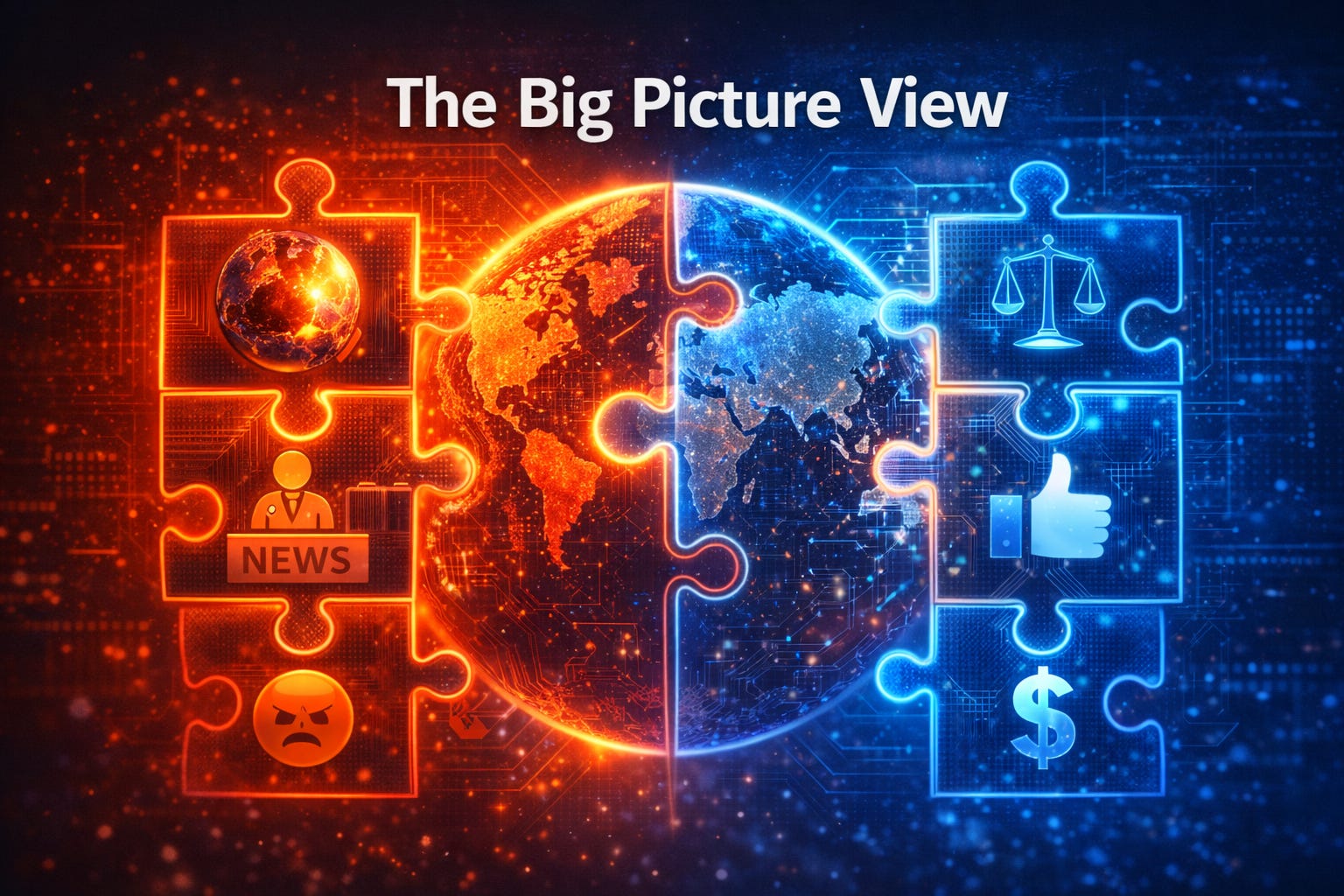
Most people see fragments: Social media is toxic. Politics is insane. Both parties are corrupt. Rich keep getting richer.
Here's how it connects:
Algorithms optimize for outrage
→ outrage is profitable
→ angry people stay online
→ more ads
→ billions in revenue
→ buy politicians
→ politicians protect the model
→ platforms keep optimizing
→ cycle accelerates.
It's one system. Working exactly as designed.
In 2025, while this system ran, billionaire wealth hit $18.3 trillion. The top 10 gained $579 billion. Democracy fragmented further.
Not because of conspiracy. Because of a simple business model: your outrage = their money.
So What Now?
You can keep scrolling, fighting with strangers, voting and wondering why nothing changes, making them richer while democracy fragments.
Or you can face reality:
Democracy is too broken to save itself through normal channels.
Use tools that don't require politicians' permission:
Economic pressure (boycotts)
Social unity (organize across divisions)
International support (France, EU enforcement)
Alternative structures (build systems they don't control)
Will this restore democracy? Honestly—maybe not.
Will this create space to build something better? Yes, it can.
Is it worth trying? What's the alternative?
The Choice
Disney showed you: When consumers organize, they lose $5 billion in a week.
Minnesota showed you: When communities use localized networks to unite across political lines, authorities back down.
France showed you: Some democracies still enforce laws against billionaires.
The question isn't "Can we prevent this?"
It already happened.
The question is: "Can we build enough collective power to survive it—and build something better?"
In my next essay, I'll show you exactly how they purchased both political parties, why voting alone won't save us, and what tools actually might work when democracy is too fragmented to regulate itself.
But first, you need to see the whole picture.
Now you do.
Your move.
Bette Hanson is the founder of Multi Dimensional Healing, a consciousness-level practice offering personal sessions and group work. Her approach integrates personal healing with collective transformation, grounded in the understanding that individual patterns and systemic power structures operate from the same fractured consciousness. She writes to help people see clearly how power operates—and recognize their agency to build something better.